 Skip to content

Published 11 July 2026 Last reviewed 1 September 2026 By SMC Custom Installs
If you’re a builder or main contractor (or a homeowner whose builder is already on site), the short answer is this: we slot into your build programme like any other trade. We come in at the plans stage to mark up drawings, run our cables alongside the electrician’s first fix, come back for second fix after decoration, and commission everything at the end. We’ve been doing it since 2006, on new builds, renovations and extensions across Shropshire, and we’d like to think we’re easy to have on site.
Key points
- We work with any local builder or main contractor: there’s no approved list and no exclusivity
- Involve us at the plans stage, before first fix, and everything gets cheaper and cleaner
- We mark up your drawings: cable routes, keypad and speaker positions, blind pockets, containment and rack location
- We fit around your programme: first fix with the electrician, second fix after decoration, commissioning at the end
- Six-person team with a real office in Shrewsbury, so someone answers the phone for the whole build
Where we fit in the build programme
Smart home work isn’t one visit — it’s three or four short ones, timed to your programme. Here’s the pattern we follow on almost every job:
- Plans stage: before anyone is on site, we sit down with the drawings and agree what goes where. This is the visit that saves everyone money later.
- First fix: we run our cabling alongside the electrician’s first fix (same window in the programme, before boarding and plastering). Speaker cable, network cable, control wiring, blind power, containment where it’s needed. We coordinate with your electrician directly so nobody is waiting on anybody.
- Second fix: after decoration, we come back for keypads, speaker grilles, wireless access points and the visible kit. By this stage the messy work is long done.
- Commissioning: at the end, usually in the final week or two, we set the system up, test every room and hand over to the client. This is the part the client remembers, and it reflects on you as much as on us.
If you want the longer version of what happens at each wiring stage, we’ve written it up separately: when to involve a smart home installer in your wiring.
What we do at the plans stage
The single most useful thing a builder can do is send us the drawings before first fix. Give us a set of plans and we’ll return them marked up with everything your trades need to know:
- Cable routes: where our runs go, so they can be allowed for alongside the electrical design rather than argued over on site
- Keypad positions: agreed with the client (and the interior designer, if there is one) so back boxes go in once, in the right place
- Speaker positions: coordinated with downlights, smoke detectors and joist runs before the ceiling is boarded
- Blind pockets: concealed blinds need a pocket formed in the window reveal or ceiling, and that has to be in the drawings, not improvised later
- Containment: where we need conduit or trunking left in, particularly through steels, slabs and external walls
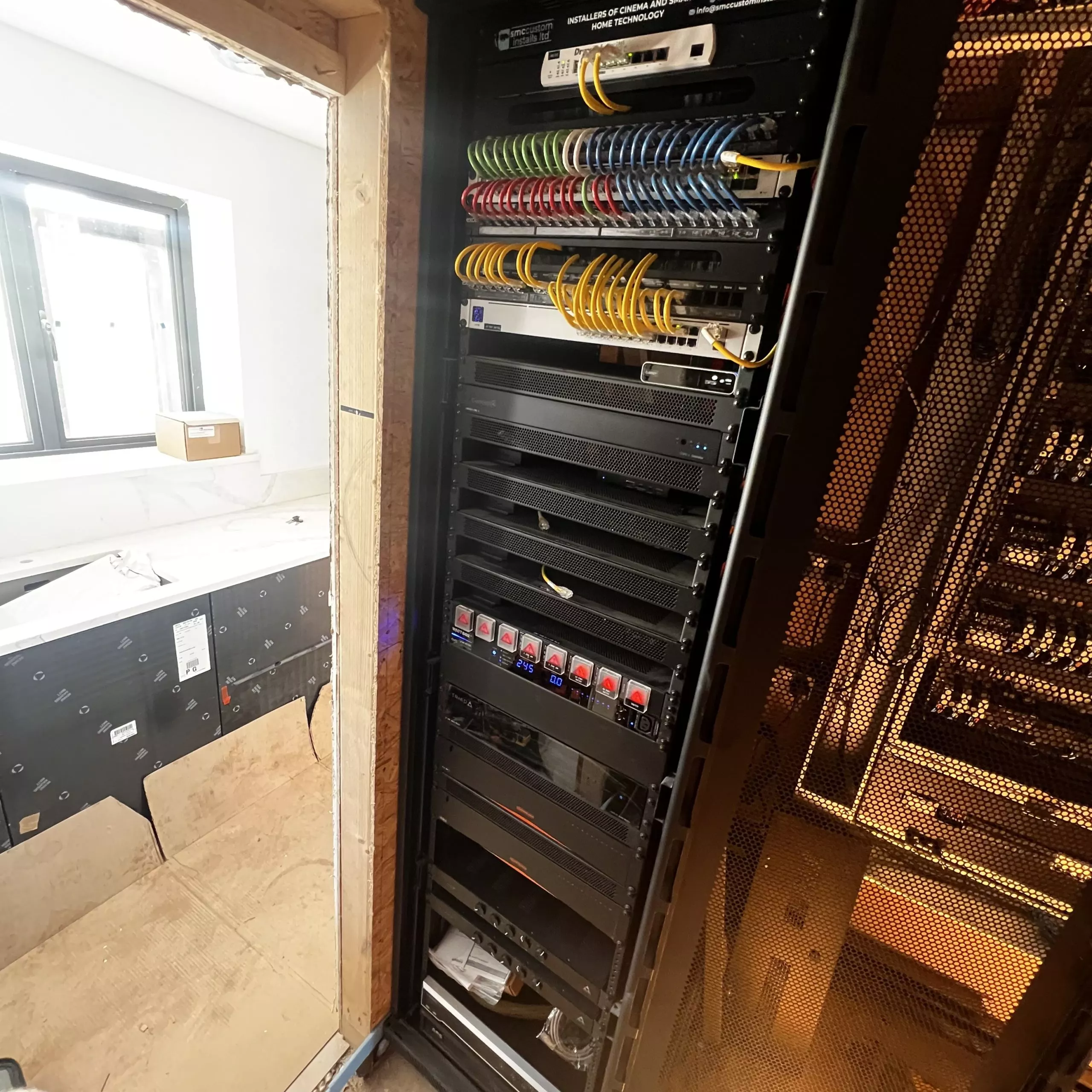
- Plant and rack location: the equipment cabinet needs a home with power, ventilation and sensible access; a plant room, garage corner or understairs cupboard agreed at plans stage beats a loft compromise every time
None of this costs the builder anything at drawing stage. All of it costs money to put right after plastering. That’s the whole argument for early involvement, and it’s why we’d always rather see a plan than a finished wall.
What we’re like on site
Builders care less about what a system does and more about whether the subcontractor turns up, works clean and doesn’t hold up the programme. Fair enough. So, plainly:
- We’re insured and used to site rules. Inductions, CDM requirements, permits, signing in: we’ve worked on managed sites for years and we don’t need chasing on paperwork.
- We work tidy. Cables dressed and labelled, our waste off site, first fix photographed before boarding so there’s a record of exactly what’s in the walls.
- One point of contact. You get a named person who knows your job, not a call centre. Design, installation and programming are all done by the same in-house team, so there’s no finger-pointing between a designer in one company and an installer in another.
- Someone always answers the phone. We’re a six-person team with a real office and showroom in Shrewsbury. If your plasterer is standing next to a wall and needs to know whether a cable can move, you can get an answer that morning on 01743 234945.
- We fit your programme, not the other way round. Dates slip on every build; we know that. Tell us the week, we’ll be there in the week.
And the part that matters at the end: when the client walks through at handover and the lighting, heating, audio and blinds all just work, that reflects on the builder who ran the job. Our aim, honestly, is to make you look good on handover day.
Already past first fix? It’s not too late
If the walls are closed, don’t panic — and don’t assume the client has missed the boat. A good deal of what we do, from lighting control to audio and networking, has wireless options designed exactly for this situation. Lutron’s wireless lighting control, for example, was built for finished houses.
Two honest caveats. First, wired is still the gold standard for speakers, networking and anything that needs to work flawlessly for twenty years. So if there’s any wall still open, or a floor still up, it’s worth a phone call before it’s closed. Second, first fix is always the cheaper and cleaner route: running a cable through an open stud wall takes minutes; getting the same cable into a decorated one takes patching, filling and repainting. If the plasterboard is going on next week, this week is the time to ring us.
Working alongside other professionals is normal for us. We’ve written about how that works with interior designers, and the same applies to builders: we’re not tied to anyone, we don’t keep a closed list, and we genuinely welcome a call from any local builder with a job on, whether it’s a one-off plot or you’d like an installer you can bring to every project. The whole picture, designers and electricians included, is on our working with the trade page.
Frequently asked questions
Do you only work with certain builders?
No. We work with any builder or main contractor: local firms, self-builders’ contractors, main contractors on managed sites. There’s no approved list, and if we haven’t worked with you before, that’s no obstacle at all.
When should the builder get you involved?
At the plans stage, before first fix, ideally as soon as the electrical design is being thought about. That’s when marking up cable routes, keypad positions and blind pockets costs nothing. If you’re past that point, call anyway: the sooner we see the job, the more options stay open. If your project has just cleared planning, our before-first-fix guide runs through the nine decisions worth making before the walls close, and we’ll review your plans free.
Will you hold up our programme?
No — our work is timed to yours. First fix happens in the same window as the electrician’s, second fix after decoration, and commissioning at the end. We agree dates with the site manager and we keep them, and because there are six of us with an office in Shrewsbury, you can always get someone on the phone if the programme moves.
The client only decided they want this after the build started. Is it too late?
Usually not. Wireless lighting control and other retrofit-friendly kit means a lot is still possible in a closed-up house, and anything still open on site can be wired properly. Ring 01743 234945 or use the contact form and we’ll tell you straight what’s worth doing at the stage you’ve reached.
Questions About Any of This?
Whether you already own a system that’s playing up or you’re just starting to plan your first project, tell us what’s on your mind and you’ll get a plain answer from the team. Based in Shrewsbury, working across Shropshire, Cheshire, Staffordshire, the West Midlands and the Welsh borders.
Book a Showroom Demo Book a 20-Minute Call Get In Touch Or call 01743 234945 · info@smccustominstalls.co.uk