 Skip to content

Published 11 July 2026 By SMC Custom Installs
The room you listen in shapes the sound as much as the equipment playing into it, and often more. Before spending anything on new speakers or amplification, a few changes to furnishings, layout and seating position will usually buy a bigger improvement than the same money spent on kit. Here’s what to try first, in order, and how to tell when proper acoustic treatment is genuinely worth it.
Key points
- Hard, bare rooms smear dialogue and detail; soft furnishings are the cheapest acoustic treatment there is.
- First reflection points (the wall and floor spots where sound bounces on its way to you) matter most.
- Seating position, especially distance from the rear wall, changes bass more than most equipment upgrades.
- Symmetry around the screen helps the front soundstage lock into place.
- Purpose-made treatment is worth it in dedicated rooms, after the free improvements are done.
Why the room matters so much
Only part of what you hear travels straight from the speakers to your ears. The rest arrives a fraction later, bounced off walls, floor and ceiling. In a hard, echoey room those reflections blur dialogue, flatten the sense of space and make loud scenes tiring.
The clap test tells you where you stand: clap once in the empty room. A sharp ringing or fluttery echo means reflections are running wild, and everything below will help. A quick, dull “thud” means the basics are already reasonable.
Start with soft furnishings
Soft materials absorb sound reflections, and most of them are things the room might want anyway:
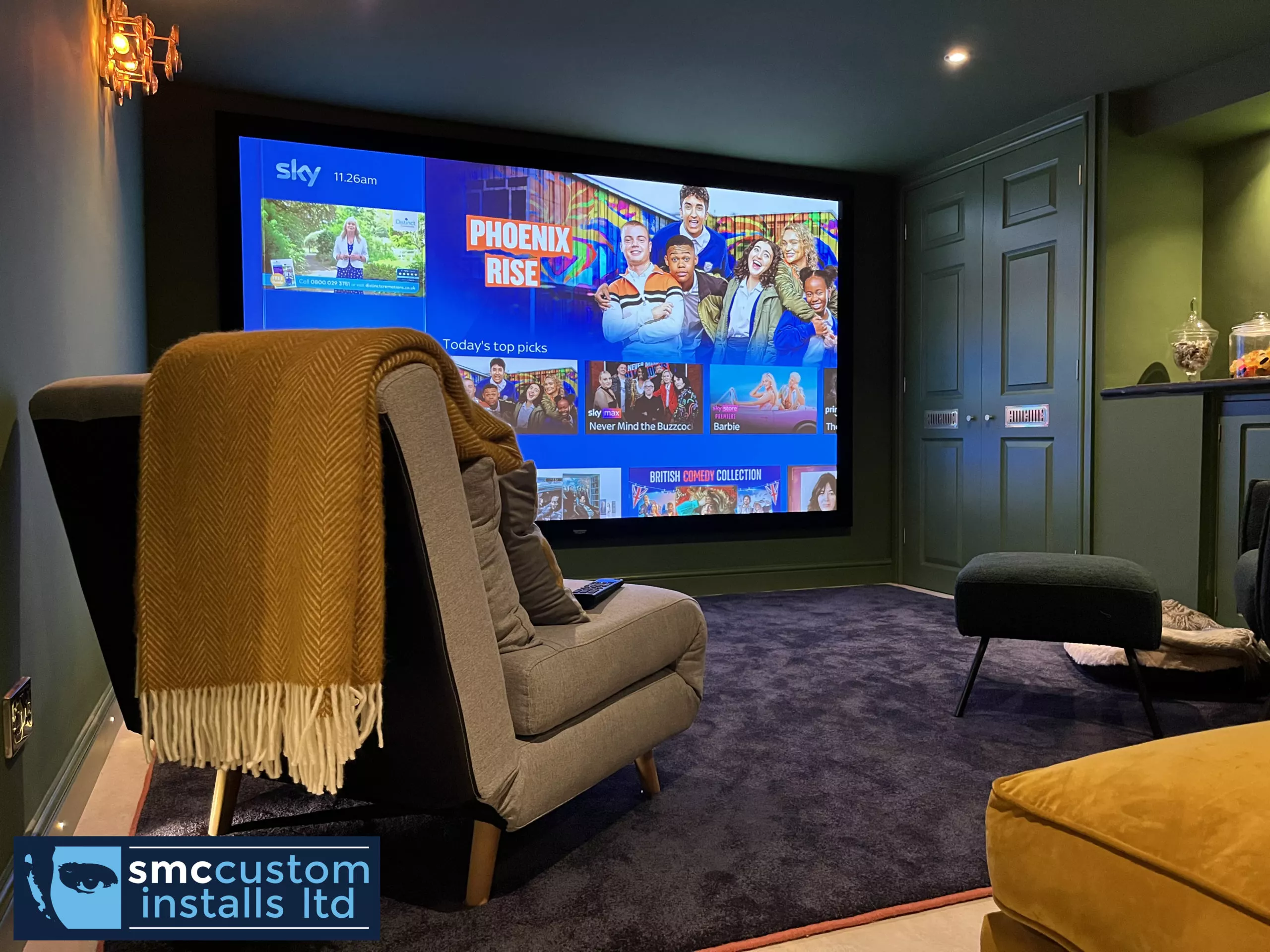
- A thick rug between the speakers and the seats, if the floor is wood or tile. This is the single biggest free win in most rooms.
- Heavy curtains, which tame both glass (acoustically the worst surface in the room) and stray daylight.
- A fabric sofa rather than leather; upholstered seating is quietly doing absorption duty for the whole room.
- Filled bookshelves, which break up flat wall surfaces and scatter reflections rather than bouncing them straight back.
Balance matters: a completely soft, over-damped room sounds lifeless. You’re aiming for a room that sounds calm when you talk in it, not padded.
Find your first reflection points
The reflections that do the most damage are the first ones: the single bounce off each side wall between the front speakers and your ears. There’s a simple trick to find them: sit in your seat and have someone slide a mirror along the side wall. Wherever you can see a front speaker in the mirror, that’s a first reflection point.
Whatever you place there — a curtain, a tapestry, a padded panel, a well-stuffed bookcase — will noticeably sharpen dialogue and tighten the stereo image. Do both side walls, and remember the floor between speakers and seat (the rug again) is a reflection point too.
Move the seats before you move money
Bass behaves unevenly in rectangular rooms: it piles up at walls and cancels in other spots. The most common victim is the sofa pushed hard against the back wall, where bass booms and thickens.
- Pull the main seating away from the rear wall if the room allows — even a modest gap helps.
- Avoid sitting exactly halfway between front and back walls, where some bass notes cancel almost completely.
- Experiment: play a bass-heavy scene and listen from different positions. The differences are not subtle, and the fix is free.
Subwoofer position follows the same physics: moving a sub along a wall can change its output character dramatically. When we calibrate a home cinema installation, speaker and seating placement comes before any electronic correction, because no processor fully rescues a bad layout.
Keep the front of the room symmetrical
Your front left and right speakers should meet mirror-image conditions: similar distance to their side walls, similar surfaces beside them. A bare wall one side and an open doorway the other pulls the soundstage sideways and unsettles the centre image. You can’t always fix architecture, but matching what’s near each speaker, and keeping large reflective furniture out of the immediate speaker area, gets you most of the way.
When proper treatment is worth it
Once the free improvements are in place, purpose-made acoustic treatment is the next step, and in a dedicated cinema room it’s genuinely worth budgeting for, often ahead of the next equipment upgrade. Broadly:
- Absorption panels at reflection points do what the curtains did, but more consistently and predictably.
- Bass management (corner treatment and considered subwoofer placement) addresses the low-frequency problems soft furnishings can’t touch.
- Fabric-wrapped walls in dedicated rooms hide treatment (and speakers) entirely, which is how professional rooms get their look.
Treatment is worth serious money in a dedicated room with good equipment; it’s overkill for a family lounge that hosts occasional film nights. If you’re unsure which side of that line your room falls on, that’s a conversation we have often. Get in touch, or read more about our cinema design approach.
Frequently asked questions
How much difference do these changes really make?
In a hard, bare room: more than most equipment upgrades, and often for little or no money. Clearer dialogue and tighter bass are the two improvements people notice immediately.
Do I need special acoustic panels, or will normal furnishings do?
Start with furnishings: rug, curtains, fabric seating, bookshelves. Purpose-made panels are more effective per square metre and more predictable, but they’re the second step, not the first.
Can room correction software fix my room instead?
Calibration in modern AV processors helps considerably, and we run it on every system we install, but it works best in a reasonable room. It fine-tunes; it doesn’t undo an empty echoing box or a sofa jammed against the back wall.
Does any of this apply to music systems too?
All of it. Reflections, symmetry and seating position affect stereo listening just as much, arguably more, since music exposes the midrange where reflections do their damage. The same steps in this article apply to a music room or listening space.
Questions About Any of This?
Whether you already own a system that’s playing up or you’re just starting to plan your first project, tell us what’s on your mind and you’ll get a plain answer from the team. Based in Shrewsbury, working across Shropshire, Cheshire, Staffordshire, the West Midlands and the Welsh borders.
Book a Showroom Demo Book a 20-Minute Call Get In Touch Or call 01743 234945 · info@smccustominstalls.co.uk