 Skip to content

Published 11 July 2026 Last reviewed 27 August 2026 By SMC Custom Installs
Lutron and Silent Gliss are the two names you will hear most often when you start looking into motorised window coverings, and the honest answer is that they are not really rivals. Lutron is a lighting-control company whose blinds and shades are one part of a wider ecosystem; Silent Gliss is a Swiss specialist in motorised curtain tracks. In most of the homes we work on, the right answer is not one or the other: it is Lutron on some windows and Silent Gliss on others, chosen room by room.
Key points
- Lutron makes motorised blinds and shades as part of a lighting-control ecosystem. They can run standalone from an app and keypads, or as part of a whole-house system.
- Silent Gliss specialises in motorised curtain tracks: the track and motor are theirs, the fabric is entirely your choice.
- Lutron offers wire-free battery options with multi-year battery life, useful where cabling is difficult.
- Silent Gliss tracks are at their best when wired into a control system such as Control4, where curtains join lighting and blind scenes.
- The two coexist happily: Lutron blinds and Silent Gliss curtains on the same window is a common and sensible combination.
Two companies, two different starting points
To compare them fairly, it helps to understand where each company comes from.
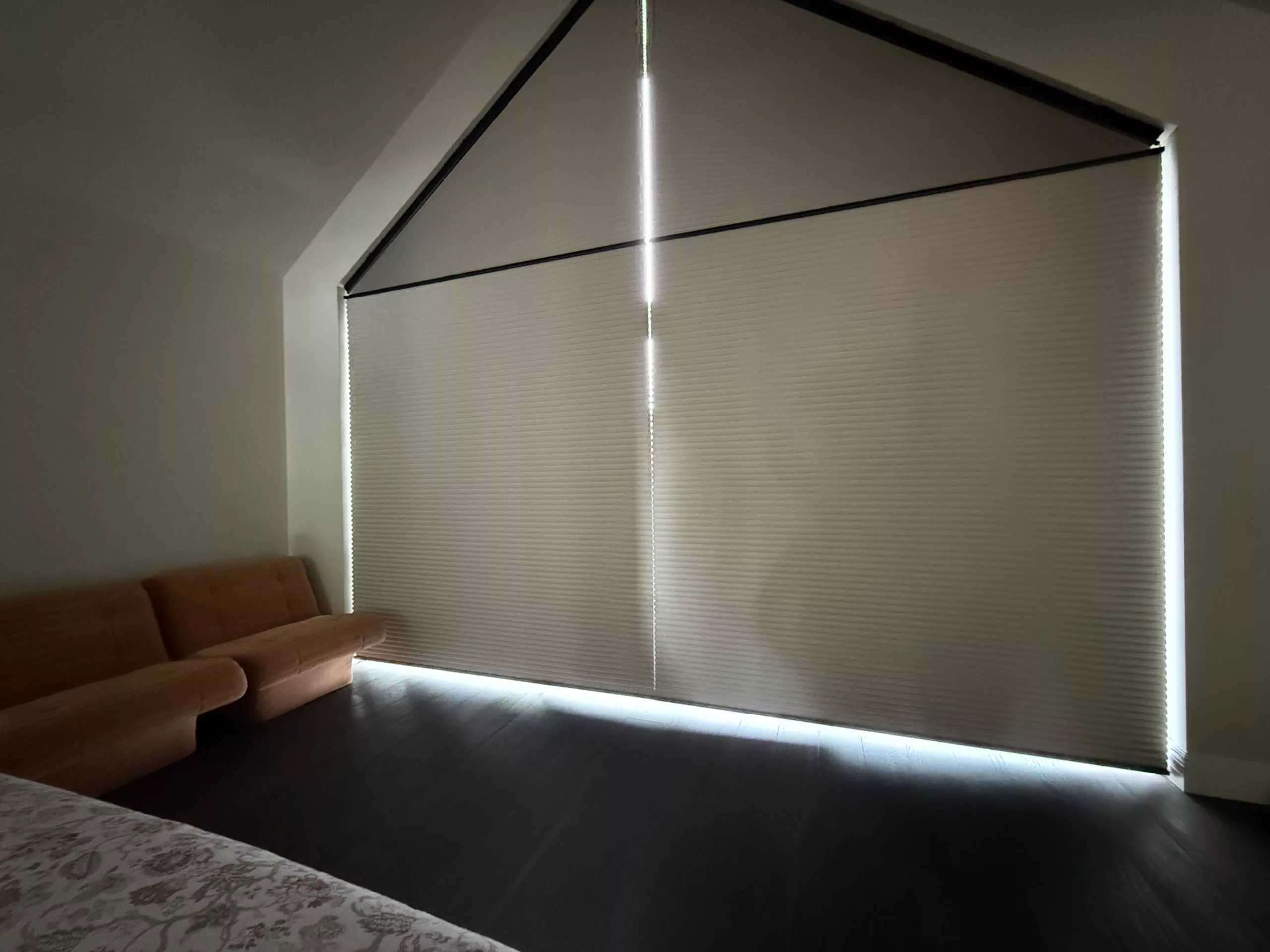
Lutron started in lighting control and grew into shading because light through a window is still light. Its motorised roller blinds, Roman blinds and honeycomb shades are designed to be scheduled, scened and dimmed alongside your lamps and downlights. The Lutron systems we install, from RA3 through to HomeWorks, treat a blind as another light source to be managed: shading drops as the afternoon sun swings round, then a single “Evening” press closes the blinds and brings the lamps up together.
Silent Gliss comes from the opposite direction. It is a curtain hardware company first: tracks, gliders and motors engineered so that a full-length pair of curtains moves smoothly and very quietly. It does not sell you a finished curtain; it sells the mechanism, and your curtain maker dresses it in whatever fabric you have fallen for. That distinction matters more than any specification sheet.
What Lutron does best
Lutron’s strength is precision shading inside a control ecosystem. A few things stand out in practice:
- Quiet, accurate movement. Lutron blinds move at a controlled speed and stop at exact, repeatable positions, so a bank of three blinds across a kitchen wall aligns perfectly rather than finishing at three slightly different heights.
- Palladiom. Lutron’s flagship shading range makes a design feature of the hardware: exposed brackets in hand-finished metals rather than a plastic cassette to hide. The wire-free Palladiom version runs on standard D-cell batteries with a claimed life of three to five years, which means motorised shading on windows where running cable would mean chasing walls.
- Standalone or integrated. A Lutron system works perfectly well on its own, controlled from the Lutron app, handheld remotes and wall keypads, with schedules and scenes built in. If you later add Control4 or expand into whole-house lighting, the blinds come along without being replaced.
- Blinds and lighting as one system. Because the shading and the lighting share a brain, daylight and electric light are managed together: one keypad button can set both.
The trade-off: Lutron shading is strongest in blind formats (rollers, Romans, honeycombs). It does offer drapery hardware, but curtain tracks are not the centre of its range, and fabric options run through Lutron’s own programme rather than being fully open.
What Silent Gliss does best
Silent Gliss has spent decades doing one thing to a very high standard: moving curtains.
- Any fabric, any curtain maker. Because you are buying a track rather than a finished product, there is no fabric book to choose from. Interlined velvet, sheer linen, a fabric your designer specified years ago. If it can be made into a curtain, it can hang on the track.
- Genuinely quiet motors. The name is not marketing. A well-installed Silent Gliss track moving a heavy pair of curtains is quiet enough to use in a bedroom while someone is asleep, and quiet operation is exactly what you want in a cinema room, where blackout curtains should close without competing with the film.
- Heavy curtains and awkward shapes. Tracks such as the Autoglide 5100 handle curtains up to around 30 kg, and Silent Gliss tracks can be curved to follow bay windows, something blind systems simply cannot do.
- Sensible manual behaviour. Touch-and-go operation means a gentle pull on the fabric starts the motor, and a manual override lets you draw the curtains by hand in a power cut. Nobody is locked out of their own curtains.
- Built to integrate. Silent Gliss motors work with the major control platforms, including Control4, Crestron and KNX. The plug-in Autoglide tracks suit single-room retrofits; the hard-wired ranges are designed to be wired into a control system from the start.
The trade-off is the mirror image of Lutron’s: Silent Gliss is hardware, not an ecosystem. On its own you get a remote or a wall switch. The scheduling, scenes, voice control and “everything closes at dusk” behaviour come from the control system it is wired into, which is why we usually specify Silent Gliss as part of a Control4 project rather than in isolation.
| Feature | Lutron | Silent Gliss |
|---|---|---|
| What it is | Motorised blinds and shades within a lighting-control ecosystem | Specialist motorised curtain tracks and motors |
| Best at | Precise, aligned blinds managed alongside lighting | Quiet movement of curtains in any fabric, including heavy and curved runs |
| Control | Lutron app, keypads, remotes and schedules out of the box | Remote, wall switch or touch-and-go pull; scenes and schedules via a control system |
| Integration | Native to Lutron RA3/HomeWorks; integrates with Control4 | Works with Control4, Crestron and KNX systems, among others |
| Fabric choice | Lutron’s fabric programme for its blind ranges | Completely open: any curtain from any maker |
| Power options | Mains-wired or wire-free battery (Palladiom wire-free runs on D-cells, 3–5 years claimed) | Plug-in tracks for retrofit, or hard-wired for integrated projects; manual override |
The realistic answer: most houses want both
Framing this as a versus is slightly artificial, because the two systems rarely compete for the same window.
A typical project we design looks like this: Lutron roller blinds handle glare and privacy on the kitchen glazing, landing windows and home office, where a neat blind is the right tool. Silent Gliss tracks carry the full-length curtains in the sitting room, master bedroom and cinema, where fabric, softness and silence matter. In bedrooms, the two share a window — a Lutron blackout blind for darkness, Silent Gliss curtains over the top for warmth and looks — and one button closes both.
Tied together through Control4 or a Lutron whole-house system, the distinction disappears day to day. “Goodnight” closes every blind and curtain in the house; the cinema curtains draw when you press play. Which motor sits behind which fabric becomes an engineering decision we make for you, window by window. There is more on how we approach this on our motorised window coverings page.
When one clearly wins
Choose Lutron when the window wants a blind rather than a curtain; when you want shading and lighting designed as one system; when cabling is impractical and a wire-free battery shade solves the problem; or when precise alignment across a run of windows is the priority.
Choose Silent Gliss when the window wants curtains — full stop. A specific fabric, a heavy interlined pair, a bay window needing a curved track, or a cinema that needs blackout to arrive in near silence: that is track territory, and it is what Silent Gliss builds for.
How SMC fits in
We are an authorised Lutron dealer and a Control4 Certified Showroom based in Shrewsbury, and we design and install Silent Gliss motorised curtain systems as part of our integrated projects. That means we are not tied to selling you one answer: we specify Lutron where a blind is right, Silent Gliss where a curtain is right, and make sure both respond to the same keypads, schedules and scenes. If you would like to see them side by side before deciding, book a showroom visit and we will set up a demonstration around your rooms and windows.
Frequently asked questions
Can Lutron blinds and Silent Gliss curtains be controlled from the same keypad?
Yes. Integrated through Control4, one keypad press or one scene can move both. This is the arrangement we install most often. The two systems behave as one to the person using them.
Do motorised curtains still work in a power cut?
Silent Gliss tracks include a manual override, so the curtains can be drawn by hand if the power fails. Lutron’s wire-free battery shades are unaffected by a power cut altogether, since they run on their own batteries.
Can I use my own curtain fabric with Silent Gliss?
Yes. This is the system’s main advantage. Silent Gliss supplies the track and motor; your curtains are made by any curtain maker in any fabric, then hung on the track. We check the finished weight against the track’s capacity when we specify the system.
Is it worth motorising just one room to start with?
Often, yes. A plug-in Silent Gliss track or a battery-powered Lutron shade suits a single-room retrofit without rewiring, and both can be folded into a wider control system later. We would simply advise choosing hardware that leaves that door open, which is something we can walk through at the showroom.
Questions About Any of This?
Whether you already own a system that’s playing up or you’re just starting to plan your first project, tell us what’s on your mind and you’ll get a plain answer from the team. Based in Shrewsbury, working across Shropshire, Cheshire, Staffordshire, the West Midlands and the Welsh borders.
Book a Showroom Demo Book a 20-Minute Call Get In Touch Or call 01743 234945 · info@smccustominstalls.co.uk